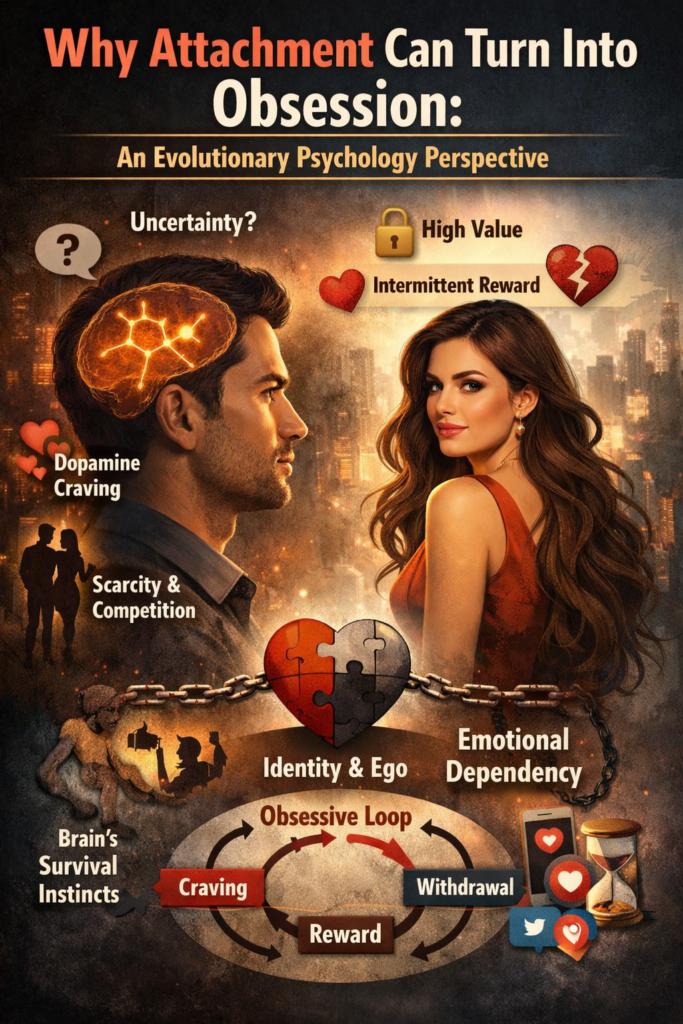
Have you ever found yourself thinking about one woman constantly—replaying conversations, analyzing her behavior, and feeling emotionally pulled toward her in a way that feels almost uncontrollable?
This isn’t just “love” or “infatuation.” From an evolutionary psychology standpoint, it’s something deeper—a powerful interaction between your brain’s attachment system, reward circuitry, and survival instincts.
Let’s break down why attachment can sometimes escalate into obsession.
1. The Brain Sees Her as High Value
Your brain is constantly evaluating potential partners, often unconsciously. When a woman signals traits associated with reproductive or emotional value—such as attractiveness, warmth, or exclusivity—your brain flags her as important.
In evolutionary terms, this translates to:
“This person could significantly impact my survival or reproductive success.”
When that signal becomes intense, your attention narrows. What starts as attraction becomes fixation.
2. The Dopamine Loop: Why It Feels Addictive
Attachment activates the same neural pathways involved in addiction.
Each interaction triggers dopamine:
- Thinking about her → small reward
- Receiving attention → strong reward
- Losing contact → withdrawal
This creates a cycle:
craving → reward → craving → withdrawal
The most dangerous trigger? Intermittent reinforcement—when her attention is unpredictable.
Your brain learns:
“Maybe the next interaction will feel amazing.”
This uncertainty keeps you hooked.
3. Scarcity Increases Desire
We are wired to value what is rare.
If she seems:
- Hard to get
- Emotionally unavailable
- Desired by others
Your brain interprets her as a scarce resource. And in evolutionary environments, scarcity meant importance.
The result:
The less available she is, the more your mind chases her.
4. Uncertainty Hijacks Your Mind
When you don’t know where you stand, your brain shifts into problem-solving mode.
Questions like:
- “Does she like me?”
- “Did I mess up?”
- “What is she thinking?”
Create a loop of constant mental activity.
You’re no longer just attached—you’re cognitively trapped.
5. Your Attachment Style Shapes the Intensity
Not everyone experiences obsession the same way.
Your early emotional experiences influence your attachment style:
- Anxious attachment → intense need for reassurance, higher risk of obsession
- Avoidant attachment → emotional distance, but obsession triggered by withdrawal
- Secure attachment → balanced, stable connection
In other words:
Biology builds the system, but experience determines how strongly it activates.
6. When She Becomes Part of Your Identity
At some point, the attachment can shift from emotional to existential.
She becomes tied to:
- Your self-worth
- Your sense of success
- Your imagined future
Now the stakes are higher. Losing her doesn’t just feel like rejection—it feels like losing a part of yourself.
7. Emotional Highs and Lows Strengthen the Bond
If she alternates between warmth and distance, your brain experiences contrast:
- High reward (attention, affection)
- Emotional drop (distance, silence)
This contrast strengthens the attachment rather than weakening it.
It’s the same principle that makes certain habits—and even toxic dynamics—hard to break.
8. Evolutionary Mismatch: The Modern Problem
Your brain evolved in a world with:
- Small social groups
- Limited romantic options
- Clear signals and outcomes
But today:
- You can idealize someone endlessly
- You can replay interactions infinitely
- You often lack closure
Your ancient brain is trying to solve a modern problem it wasn’t designed for.
The Real Mechanism Behind Obsession
When all these factors combine, you get a powerful psychological state:
Obsession = High perceived value + Uncertainty + Intermittent reward + Emotional dependency
This isn’t weakness. It’s a system working exactly as it was designed—just amplified by modern conditions.
How to Regain Control
You don’t overcome obsession by fighting your feelings directly. You change the conditions that sustain it:
- Reduce uncertainty → seek clarity or create distance
- Limit exposure → stop constant checking and mental replay
- Rebuild identity → invest in goals, purpose, and self-development
- Stabilize reward systems → focus on consistent, real-world progress
Over time, the intensity fades—not because the person changes, but because your brain recalibrates.
Final Thought
What feels like a deeply personal emotional experience is, in many ways, a biological pattern playing out beneath your awareness.
Understanding it doesn’t make it less meaningful—but it gives you something more powerful:
Control.