Introduction
Why do humans act irrationally—even when they know better?
Why do we feel anxiety in safe environments, compete with others, or form deep social bonds?
Most explanations focus on psychology or personal choice. But that’s only part of the story.
A deeper, more powerful explanation comes from evolution—popularized in works like Behave.
Human behavior is not random. It is shaped by biology, environment, and millions of years of natural selection.
Understanding this changes how you see yourself—and everyone around you.
The Darwinian Model of Human Behavior
To understand behavior, you must look beyond the moment.
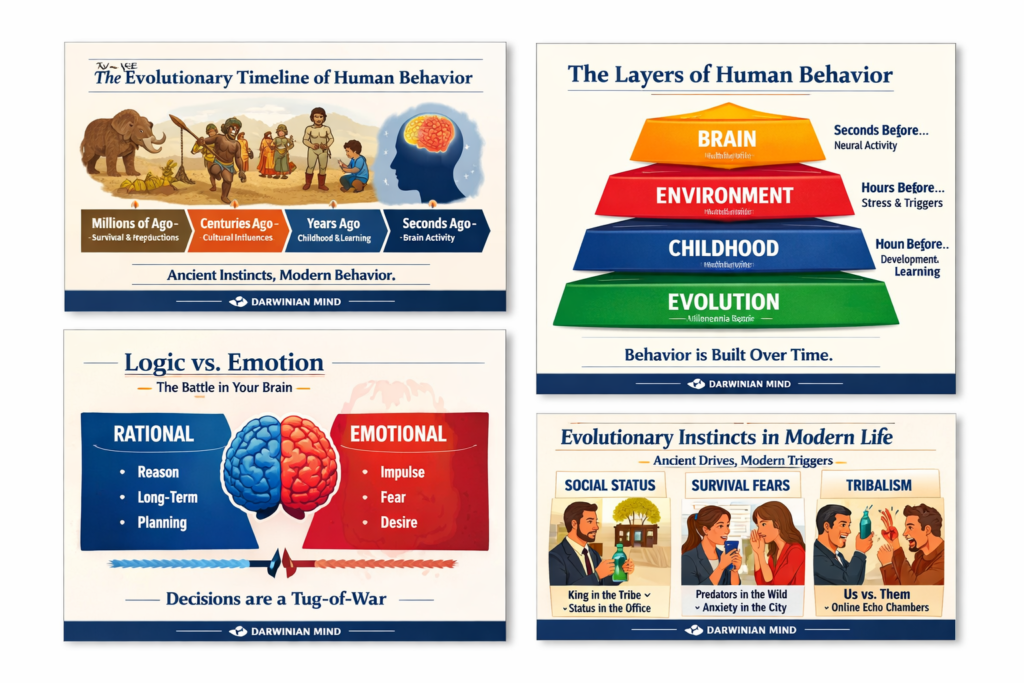
Human actions are the result of multiple layers:
1. Immediate Causes (Seconds Before Action)
- Brain activity triggers behavior
- Neural circuits decide whether you act impulsively or rationally
This is the execution layer.
2. Short-Term Influences (Minutes to Hours Before)
- Stress levels
- Hormones
- Environmental triggers
For example:
- You’re more aggressive when stressed
- You’re more cautious when afraid
3. Developmental Factors (Years Before)
- Childhood experiences
- Social learning
- Cultural conditioning
These shape your:
- Personality
- Habits
- Emotional responses
4. Evolutionary Forces (Millions of Years)
This is the most powerful layer.
Your brain evolved to solve survival and reproduction problems—not to make you happy.
Examples:
- Fear → helps avoid danger
- Attraction → drives reproduction
- Social bonding → ensures group survival
Evolution Is Still Running the System
Many people assume evolution is something from the past.
It’s not.
Evolution is embedded in your brain right now.
Your instincts are ancient:
- You seek status because it once increased survival chances
- You fear rejection because isolation meant death
- You compare yourself to others because competition mattered
These tendencies still influence your daily decisions—even in modern life.
Why Humans Are Not Fully Rational
Humans like to think they are logical.
But in reality:
Behavior is driven by competing systems in the brain.
You have:
- Emotional systems (fast, automatic)
- Rational systems (slow, deliberate)
When you:
- Overeat
- Procrastinate
- React emotionally
That’s not failure—it’s biology.
The Truth About Free Will
One of the most controversial insights from a Darwinian perspective is this:
Your choices are shaped by factors you did not choose.
You didn’t choose:
- Your genes
- Your early environment
- Your brain structure
So how free are you?
A more realistic view:
Free will exists—but within biological and environmental constraints.
You are not fully controlled—but you are not fully independent either.
The Hidden Logic Behind “Bad” Behavior
Many behaviors we judge as negative actually have evolutionary roots:
- Aggression → competition for resources
- Jealousy → protection of relationships
- Anxiety → threat detection system
- Tribalism → group survival strategy
These behaviors are not mistakes.
They are adaptations.
What This Means for Everyday Life
Understanding behavior through a Darwinian lens gives you an advantage:
1. Better Self-Control
You realize:
You don’t eliminate impulses—you manage them.
2. Less Judgment of Others
Instead of:
- “This person is bad”
You think:
- “What caused this behavior?”
3. Smarter Decision-Making
You can:
- Design environments that reduce bad habits
- Use awareness to override impulses
4. More Realistic Expectations
You stop expecting:
- Perfect rationality
- Constant motivation
And start working with your biology—not against it.
How to Apply This Knowledge
If you want to use this in real life:
Understand Your Triggers
Notice:
- When you feel stressed
- When you act impulsively
Control Your Environment
Environment shapes behavior more than willpower.
Example:
- Remove distractions instead of fighting them
Think Long-Term
Your brain is wired for short-term survival.
You must consciously:
- Plan
- Reflect
- Delay gratification
Conclusion
Human behavior is complex—but not random.
You are the result of biology, experience, and evolution interacting in real time.
Understanding this doesn’t remove responsibility.
It gives you something more powerful:
Awareness of the system that drives your actions.
And once you understand the system…
You can start to influence it.